 | |  | |  | |  | |  | |  | |  |
Cranberry History
Native fruit first cultivated in Dennis
Cranberries are a wild native fruit to Cape Cod. It is well known that Native Americans introduced cranberries to early Cape Cod settlers and
taught them how to use cranberries for medicinal purposes and to produce red dye. In the north village of Dennis, Henry Hall discovered
cultivated cranberries by accident in 1816. After cutting a stand of trees north of his bog for firewood, a northern storm blew the exposed, native
sands over his bog. Thinking his bog was ruined, Mr. Hall was amazed to find that his crop actually increased the following harvest. This event
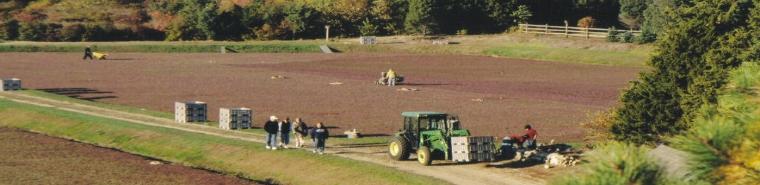
inspired Mr. Hall to move all of his cattle to “Molly’s Pasture” (the very same bog as Annie's Crannies) and experiment with the cultivation of the
native fruit. His timing was perfect. Shortly after Mr. Hall's discovery the ship building industry slowed. Many sea captains and ship builders turned
to growing cranberries to make a living. Dennis remained the cranberry cultivation center until 1850 when other cape towns joined in.
Dennis, Massachusetts was not only the birthplace of the cultivated cranberry, but to the invention and standardization of harvesting, packaging,
and shipping equipment and practices. In 1868, Captain Warren Hall invented an improved cranberry gatherer. In 1876, Luther Hall (Henry Hall’s
grandson), Zebina Hall and Captain William Crowell patented the cranberry picker. The most successful invention was William Crowell’s fruit box,
patented in 1877, which is still used today for cranberries and other fruits. Dennis cranberry growers were also instrumental in standardizing the
methodology for branding the variety, size, quality and durability of cranberries which became the Rules for Branding in the 1880’s.
Cranberries are a wild native fruit to Cape Cod. It is well known that Native Americans introduced cranberries to early Cape Cod settlers and
taught them how to use cranberries for medicinal purposes and to produce red dye. In the north village of Dennis, Henry Hall discovered
cultivated cranberries by accident in 1816. After cutting a stand of trees north of his bog for firewood, a northern storm blew the exposed, native
sands over his bog. Thinking his bog was ruined, Mr. Hall was amazed to find that his crop actually increased the following harvest. This event
inspired Mr. Hall to move all of his cattle to “Molly’s Pasture” (the very same bog as Annie's Crannies) and experiment with the cultivation of the
native fruit. His timing was perfect. Shortly after Mr. Hall's discovery the ship building industry slowed. Many sea captains and ship builders turned
to growing cranberries to make a living. Dennis remained the cranberry cultivation center until 1850 when other cape towns joined in.
Dennis, Massachusetts was not only the birthplace of the cultivated cranberry, but to the invention and standardization of harvesting, packaging,
and shipping equipment and practices. In 1868, Captain Warren Hall invented an improved cranberry gatherer. In 1876, Luther Hall (Henry Hall’s
grandson), Zebina Hall and Captain William Crowell patented the cranberry picker. The most successful invention was William Crowell’s fruit box,
patented in 1877, which is still used today for cranberries and other fruits. Dennis cranberry growers were also instrumental in standardizing the
methodology for branding the variety, size, quality and durability of cranberries which became the Rules for Branding in the 1880’s.
In 1843, in the north village of Dennis on Scargo Lake, Eli Howes and James Paine Howes
developed the Howes variety. [The Howes berry can be picked wet or dry].
The Howes Variety:
• Only grown in Massachusetts so local means fresh
• Ripens later in the season than other varieties, just in time for the holiday season
• Naturally stays fresher longer = better keeping quality
• More rot resistant
• Can be picked wet (by flooding bog) for juicing or dry for cooking
When purchasing "fresh fruit" you want dry harvested to insure quality!
developed the Howes variety. [The Howes berry can be picked wet or dry].
The Howes Variety:
• Only grown in Massachusetts so local means fresh
• Ripens later in the season than other varieties, just in time for the holiday season
• Naturally stays fresher longer = better keeping quality
• More rot resistant
• Can be picked wet (by flooding bog) for juicing or dry for cooking
When purchasing "fresh fruit" you want dry harvested to insure quality!
Did you know?
Like other fruits there are many varieties of
cranberries. Although there have been 168
recorded varieties of cranberries, only 68 are
still grown today. The only fresh fruit grown on
Cape Cod today are Early Blacks and Howes
varieties. At Annie’s Crannies we grow the
Howes variety.
Like other fruits there are many varieties of
cranberries. Although there have been 168
recorded varieties of cranberries, only 68 are
still grown today. The only fresh fruit grown on
Cape Cod today are Early Blacks and Howes
varieties. At Annie’s Crannies we grow the
Howes variety.
| ||||||||||||||

| 1816 Bicentennial of the Cultivated Cranberry 2016 at its Origin, Dennis, Massachusetts |
| In the Year 1816 |
